DENISE LEVERTOV AND THE MUSIC OF RISK
[Last month, I had the pleasure of leading “Denise Levertov and the Music of Risk,” a two-day seminar on Levertov, followed by a reading of Levertov’s work and that of the seminar participants, at the 11th Poetry by the Sea Conference in Madison, Conn. The presenters—fine poets and brilliant interpreters of poetry all—were Patricia Behrens, Mia Grogan, Elizabeth Lara, Dawn Manning, Wendy Sloan, and Joyce Wilson. Following is an edited version of my introduction to the seminar.]
With some confidence, I can say that the choice of Denise Levertov as the subject of this year’s Poetry by the Sea Master Poets Critical Seminar is the result of crowd sourcing.
Last October, I reposted Levertov’s well-known poem “To the Reader” on my Facebook page. When I first posted it in 2020, my comment was: “An environmental poem by Denise Levertov decades & decades before its time.”
Six years ago, my post received only four likes and no comments. Last year’s reposting, however, got 14 likes and this comment: “Perhaps Levertov would be a good poet for your workshop at PBtS.”
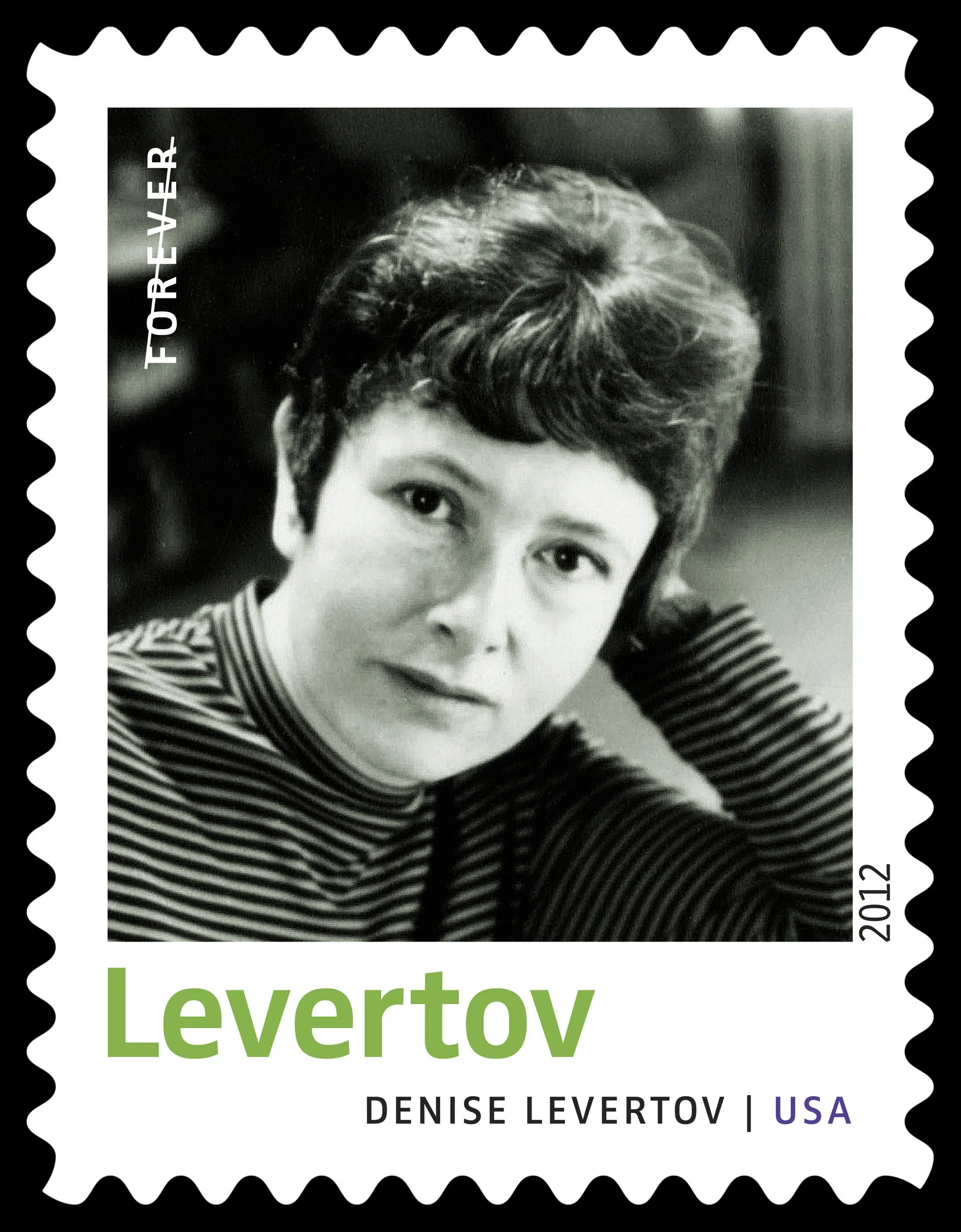
Denise Levertov U.S. postage stamp, issued 2012
Although I did have to get PBS board approval for the previous three seminar subjects—Marianne Moore, Elizabeth Bishop, and W.H. Auden—I chose them with very little feedback from the PBTS community at large. Now, however, I have the invigorating sense of beginning this seminar with the substantial assurance of enthusiasm for the poet whose work we’re studying.
Especially refreshing is that an interest in Denise Levertov emerged from the Poetry by the Sea community. With some variations, I think it’s fair to say that poets attending the conference tilt in the direction of what was once called the New Formalism. By that I mean a tendency to choose pre-existing traditional poetic forms and regular meters for their poems as well as a predisposition against free verse.
Crude as such generalizations are, I’m thrilled that the interest in Levertov here may well prove me wrong. Are we coming to the end of the form vs. free verse, academic vs. bohemian war that has divided American poetry since just after World War II?
The interest in Levertov indicates to me a revived openness to experimentation and precise expressiveness, along with a willingness to explore the kind of nontraditional musicality she advanced in her poetry and essays.
The coarsest enemies of free verse have criticized it as mere prose broken up into lines. But Levertov’s work can open the minds of prosodically minded poets to other kinds of scansion and new aural and visual approaches via close attention to the poetic line.
In our troubled times, her political poetry also offers us a model for how to compose our own responses to the zeitgeist. In our darker moments we also might discover in Levertov’s late spiritual verse a way to open our own poems to analogous quests.
From my own standpoint, I’m delighted to have the chance to return to my poetic origins in the late 1960s through the 1980s. Like Levertov, my poetic ancestors include William Carlos Williams, Ezra Pound, Marianne Moore, Robert Duncan, Robert Creeley, and Charles Olson.
Although I have never been in the vicinity of Black Mountain College, where Olson was the rector and Levertov a contributor and close associate of the poets of the revered Black Mountain Review, I still regard it as a sacred place. An early mentor of mine, the poet Joel Oppenheimer, studied in those hallowed halls.
But to get to the meat of the matter, the poetry of Denise Levertov, let’s take a closer look at the poem I spoke of earlier.
As we read, to echo the poem’s refrain, we can see some of the most essential aspects—musical, visual, ethical—of Levertov’s poetry and criticism writ large.
The stylistic excellence of her poems largely derives from the sense that they’re speaking directly to us and in the present tense. Her directness of address is right there in the title, which translates the title of Baudelaire’s poem “Au Lecteur” and echoes T.S. Eliot’s famous line in “The Wasteland,” “You! Hypocrite lecteur! —mon semblable,—mon frère!”
Beginning all three stanzas with the phrase “As you read,” Levertov strengthens the effect of a poet grabbing our lapels and demanding immediate attention.
In her essays, Levertov often stresses that the use of enjambment—where and when and how a poet chooses to break a given line—can be as an important expressive tool for a free verse poet as meter and rhyme can be for a more traditionally inclined practitioner.
Indeed, one distinguishing feature of her criticism is how much it’s based on her actual practice as a poet, and we find her masterfully practicing what she preaches about line breaks at the very opening of the poem. “As you read, a bear leisurely,” she languidly stretches out in the adverb ending the first line, only to snap back in the second to the wonderfully intimate verb “pee.”
From there, the contrast of white snow and saffron urine is a perfect example of another source of her mastery: an imagism learned from Pound and Williams that’s as clear and painterly as that of her masters.
The last stanza demonstrates in expertly varied line lengths an attunement to the world outside the poem. First, there’s the appealingly clear and modest statement she appears to be making about the relationship between art and the world.
and as you read
the sea is turning its dark pages,
turning
its dark pages.
As we engage in the small act of reading her brief poem, the greater world looms vastly, vividly, dynamically around us.
The world is much larger than poetry, Levertov seems to be saying, and as readers and poets we might do well to lift our eyes from the page and see what’s going on around us.
Repeated twice in the final quatrain, the reference to the dark pages of the sea reveals by comparison how minuscule the poem can seem compared to the great workings of the natural world.
That message shouldn’t be a surprise coming from a poet who demurred by only a word from Robert Creeley’s dictum. as reported by Charles Olson in all caps in Olson’s famous essay on what he called “projective verse”: “FORM IS NEVER MORE THAN AN EXTENSION OF CONTENT.”
In less blaring upper-and-lower case, Levertov edits the sentence this way: “Form is never more than a revelation of content.”
I will leave the distinction between “extension” and “revelation” for another day. To boil down both statements to their shared essence, however, both Levertov and Creeley are asserting that the primary aspect of a poem is the living substance it’s describing, addressing, embodying, rather than the form itself.
“Revelation,” indeed, is the effect Levertov achieves in some of her greatest poems—the sense that we are present at the Creation as the poem bears direct witness to what’s happening in her presence as we read the events and details right before us. Poem and world are naked to each other.
When world and witness meet in a Levertov poem, visionary sparks often fly. With the tragedies of the Vietnam War and the need to protest against it dragging on exhaustingly, she locates a certain quiet in the prologue to the poem “Staying Alive.” Here she can envision peace as
that grandeur, that dwelling
in majestic presence, attuned
to the great pulse.
Much later, Levertov again used the word “pulse” in “On Belief in the Physical Resurrection of Jesus,” and the effect is stunning. As in more secular contexts, this poet avows physical content as the primary thing, the prerequisite to an idea or belief.
Employing Williams’s three-part line, she brings the reader into proximity to Christ’s wound via the pulse, or heartbeat, of the poem, enabling us to grasp the mysterious idea that all things may be possible:
We must feel
the pulse in the wound
to believe
that ‘with God
all things
are possible’
Form is, merely or grandly, a tool that can deliver such content to the audience or reader. Levertov’s esthetic is at the furthest imaginable remove from the idea of art for art for art sake, contending that the poem exists in service to the things of this world.
In turn, we can see how appropriate this stance was for a poet like Levertov, who, during the Viet Nam War came to view her role as that of a fierce advocate for peace, a poet whose husband Mitchell Goodman was convicted for leading protests along with Dr. Benjamin Spock and others.
Levertov clearly saw her poems of that period as manifestations of the content of her activism. Somewhat tragically, it led to the breakup of her deep, and deeply poetic, friendship with the poet Robert Duncan, according to their correspondence. Unlike Levertov, Duncan believed that war is inextricable from human behavior. As such, he felt that rather than acting as protestors against war, poets should step back and struggle with its consequences in their poetry.
A corollary issue is the role a poet’s life should play in her poetry. How much of our lives should be directly revealed—in Levertov’s word—in our poems? In what ways can we accomplish that, assuming that we should? How can we balance the urge for direct expression and description with the call for form and musicality?
In her own ways, Levertov answered those questions by placing her immediate experience of the world at the center of her poetry. In trying to capture and express that experience as honestly as she could—honesty and truthfulness were basic poetic values of hers—she learned to pursue content as it existed in what Duncan and Olson called the “open field.”
Rather than preconceive what a given poem should be about, the form it should be in, and how it should conclude, Olson declared that a poet composing by field “can go by no track other than the one the poem under hand declares, for itself.”
In a strange way, this suggests that the poem has a mind of its own embodied in a dynamic, “organic form” that the poet needs only to discover for herself. Without the aid of traditional tools and approaches, this seems like an extremely risky way to go about writing a poem—and indeed, as we can observe in Levertov’s exploratory processes, it is.
How then, does a poet compose in this frighteningly open-ended fashion?
During a reading she recorded in New York City of June 1958, when she was 34, she gave as succinct a description of her processes as I’ve encountered:
“I think that the play of vowels and consonants and the repetitions of certain words hold the poem together. I want the poem to have…an organic structure, like a thing in nature, not to follow a prescribed pattern, because one cannot tell, to my mind, how the energy of the poem is going to move until one is in the process of writing it.”
In her view, and that of other poets of the Black Mountain generation, the poet engages with that process by following a chain of perceptions. She sees the poem arising in the open field of her awareness of the world, like a plant arising from the ground.
She traces the direction of her poems out of the content before her—in legal terms, letting the facts lead where they may.
In her experienced and delicate hands, she fashions her content into verse. The verse, in turn, is simultaneously guided by what Levertov calls her inner voice. Putting it in terms of voice rightly confers a musicality upon how the verse is shaped.
Indeed, both she and Duncan conceived of the presentation of the poem on the page as a kind of musical score tracing how the poet wants the verse to sound.
Thus, a break in a line might represent a drop in pitch, a variation in line length can indicate a change in emphasis, and an extra space between phrases signal a pause or silence. Following Williams’s lesson, she felt that the ability to score gradations of sound by means of the line offered her a system of measurement far more nuanced and precise than that of traditional meter and rhyme.
Regardless of the extent to which we as poets adopt her methods, they can alert us to the musical potential of the poems we read and write. Magical as the ideas of open field composition can be seen at times, Levertov used them to create what she called “significant, expressive melody in the close tone-range of speech, not just a pretty ‘tune.’”
In her early imagistic, naturalistic poems, her extraordinarily expressive political poetry, and in the intense epiphanies of her spiritual verse, Denise Levertov provides us with models of how to liberate and enliven the music of our own poems.
Most of all, she teaches us to be alert to the content of our lives and perceptions as we compose our lines. For the poet, the meaning of responsibility, Robert Duncan wrote,“is to keep / the ability to respond.”